A fourth-grade teacher sits down to read her first set of informational essays and expects strong work from several students who stood out in third grade. What she finds is that two of them produced the same descriptive prose that made their narratives good: vivid, personal, organized around their own experience, applied to a topic that requires something else entirely. They are not struggling with writing. They are struggling with a different task that has been given the same name.
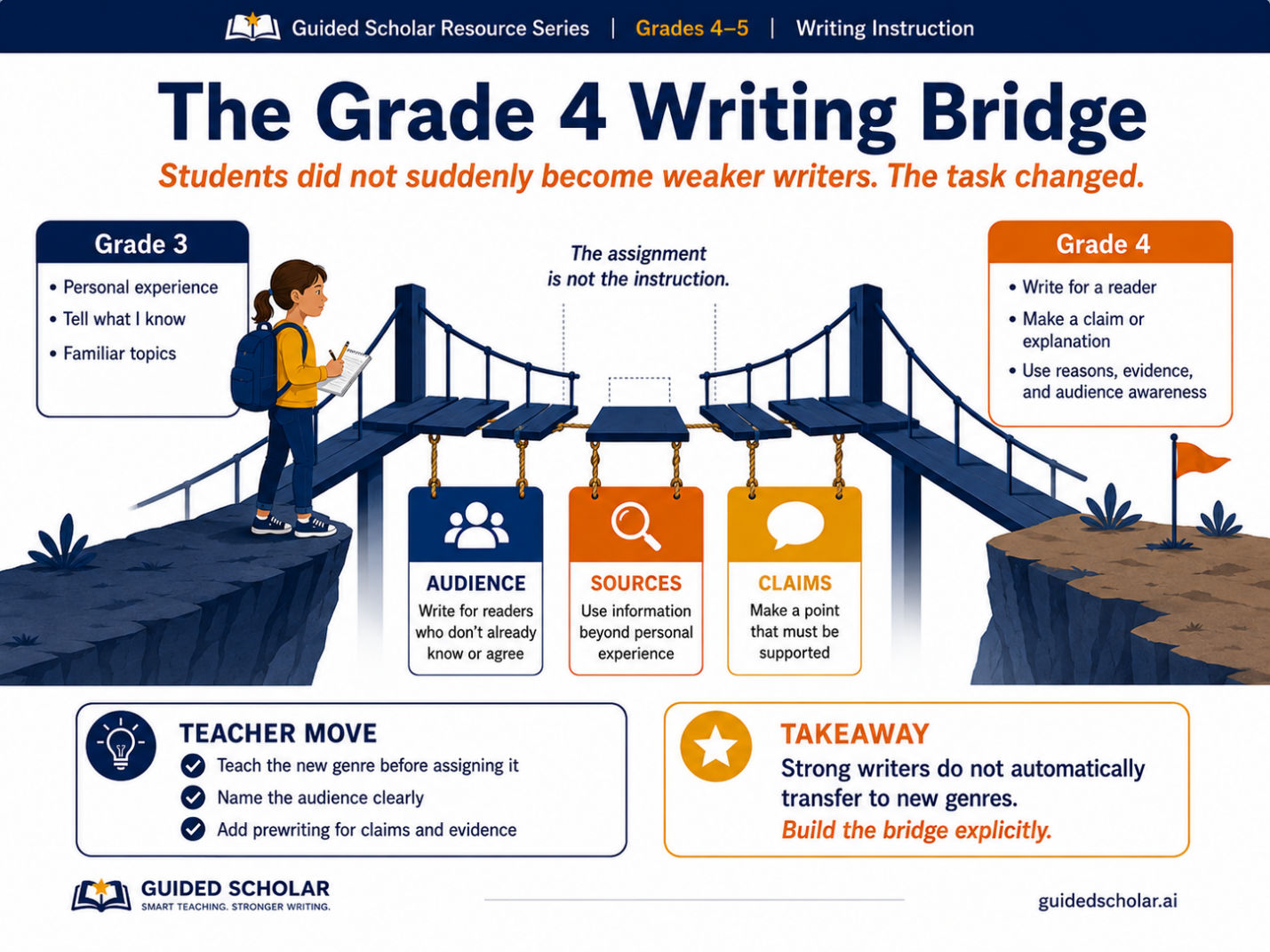
This is the writing transition problem at grade 4. Students who wrote well in third grade did not stop being capable writers. They stopped being asked for the kind of writing they know how to do. The expectation changed without the instruction catching up, and the gap that opens here is one that follows students into middle school if no one addresses it directly.
What Changes at Grade 4
Third-grade writing is anchored in personal experience: narratives about real events, opinion pieces about personal preferences, how-to writing about things the student knows firsthand. The student is both the subject and the source. Quality is measured by how clearly and vividly she communicates that experience.
Grade 4 shifts the expectation in two fundamental ways. Informational writing requires the student to become an expert on something she did not experience personally, organize knowledge for an uninformed audience, and present it clearly enough to serve a reader who knows less. Opinion writing requires the student to construct a contestable position, support it with reasons a skeptical reader would find compelling, and anticipate disagreement. Neither task is a natural extension of what third-grade writing asked for.
Common Core writing standards introduce these expectations at grade 4 with the assumption that students will rise to them with appropriate instruction. What the standards do not specify is what that instruction needs to include. Teachers are left to infer what the transition requires from standards that describe products without addressing how students develop the skills those products demand.
Three Skills That Did Not Transfer
Audience awareness is the first. Narrative writing is addressed to a sympathetic reader who shares the general experience of being human. Informational writing addresses a reader who specifically does not know what the writer is explaining. Opinion writing addresses a reader who may not agree. These are different audience assumptions, and they change what the writing must do. A student who has written for an empathetic narrative audience for two years does not automatically shift to writing for an uninformed or skeptical reader.
Source independence is the second. In narrative writing, the student is the source. In informational writing, she must select, evaluate, and organize information from outside herself. Most fourth graders have never been explicitly taught how to decide which information is relevant to their topic, how to determine what the reader needs to understand, or how to put source material in their own words. These are learnable skills that require direct instruction.
Claim construction is the third. Opinion writing requires the student to make a claim: a statement the reader might not immediately accept, that the writer must defend. Students who have been writing narratives have been making assertions about their own experience, which is inarguable by the reader. Constructing an arguable position is a different cognitive task, and most students encounter it for the first time in fourth grade without scaffolding.
Why the Form Fools Everyone
Part of what makes this transition difficult to identify is that upper elementary students often produce work that looks like informational or opinion writing without demonstrating the underlying skills. A student who knows the five-paragraph structure can produce an introduction, three body paragraphs, and a conclusion filled entirely with description, personal preference, and restatement. The form is correct. The thinking is not.
Without assessment criteria that specifically evaluate genre-specific cognitive moves, the gap looks like carelessness. The teacher marks it down as needing more detail or stronger evidence, which is accurate, but does not address why the detail is missing: the student does not yet know what kind of detail the genre requires or how to find it.
What the Research Says
Applebee and Langer’s 2006 report The State of Writing Instruction documented that the transition from personal to analytical writing is the most significant developmental challenge in elementary writing development, and the one most frequently handled through assignment without instruction. Teachers assign informational and opinion writing because the standards require it. Explicit instruction in what those genres demand cognitively is far less consistent.
Graham and Perin’s Writing Next (2007) identified explicit strategy instruction as the highest-effect intervention in writing development. Applied to the grade 4 transition, the implication is direct: students who are taught a specific process for constructing an informational explanation or an opinion argument outperform students who are assigned the task and evaluated on the result. The assignment is not the instruction.
Practical Starting Points for Teachers
- Teach genre differences explicitly before assigning the genre. A direct lesson on what informational writing does differently than narrative, for example it explains rather than describes, it draws on external knowledge rather than personal experience, it is addressed to a reader who does not already know, gives students a framework they can apply before they write.
- Use mentor texts from the target genre. Students who have read a well-constructed fourth-grade informational or opinion text have a model of what they are trying to produce. Reading the genre is a prerequisite for writing it.
- Name the audience assumption explicitly. Tell students who they are writing for. Someone who does not know what you are explaining, or someone who might not agree with your position. The audience assumption changes what the student thinks she needs to include.
- Build a genre-specific pre-writing step. For informational writing, have students list three things their reader does not yet know that they need to explain. For opinion writing, have students identify the strongest objection to their position before writing the first paragraph. These moves activate the cognitive shift the genre requires.
- Give feedback tied to genre criteria, not just writing quality. “Your writing is clear” is not genre feedback. “You explain what the term means but do not tell the reader why it matters to your argument” addresses the specific cognitive demand of the genre.
The Through Line
The transition to informational and opinion writing at grade 4 is not a maturation event. It is a skills gap that instruction needs to close. The students who struggle after strong third-grade performance are not less capable. They are encountering new cognitive demands without the support those demands require. The teacher who addresses this transition explicitly, naming what changed, teaching the skills that did not transfer, and giving feedback tied to genre-specific criteria, is doing the foundational work the standards assumed was already being done.
Sources referenced: Applebee, A.N. & Langer, J.A., The State of Writing Instruction in America’s Schools (Center on English Learning and Achievement, 2006); Graham, S. & Perin, D., Writing Next (Alliance for Excellent Education, 2007); Common Core State Standards for English Language Arts.