A sixth-grade teacher assigns a revision task and watches what happens. Most students open their documents, change a few words, fix a spelling error, and announce they are finished. He has seen this every year with every incoming class. What he has learned is that this is not a sixth-grade problem. It is a fourth-grade problem that no one fixed.
The surface-editing habit is set in the upper elementary years. By the time students reach middle school, most of them have spent two to three years in an assignment structure that did not distinguish between surface correction and substantive revision, did not require evidence that revision happened, and never showed them what revision is supposed to accomplish. The habit is not defiance. It is the fully rational product of a system that never required anything more.
Why Grade 4-5 Is the Right Window
The revision habit is not something students arrive with or without. It is something instruction builds or fails to build, and the window for building it well is grades 4 and 5 for three specific reasons.
The stakes are low enough to allow failure. A fourth grader who produces a weak revision has lost nothing of lasting consequence. This makes it the right time to push students toward a harder version of the task, substantive reconsideration rather than surface correction, without the grade pressure that makes secondary students risk-averse.
The habit is still forming. A student who has surface-edited for six months in fourth grade has a shorter correction history than one who has done so for two years through fifth grade. The earlier the instruction arrives, the less established the pattern is.
The writing is becoming complex enough to benefit from revision. Third-grade personal narratives can be improved through surface editing because the main task is clarity, not argument. Fourth and fifth-grade informational and opinion writing makes claims that could be wrong, uses evidence that could be irrelevant, and advances arguments that could be better structured. Substantive revision is newly meaningful because there is now something substantive to revise.
What Upper Elementary Revision Looks Like Without Instruction
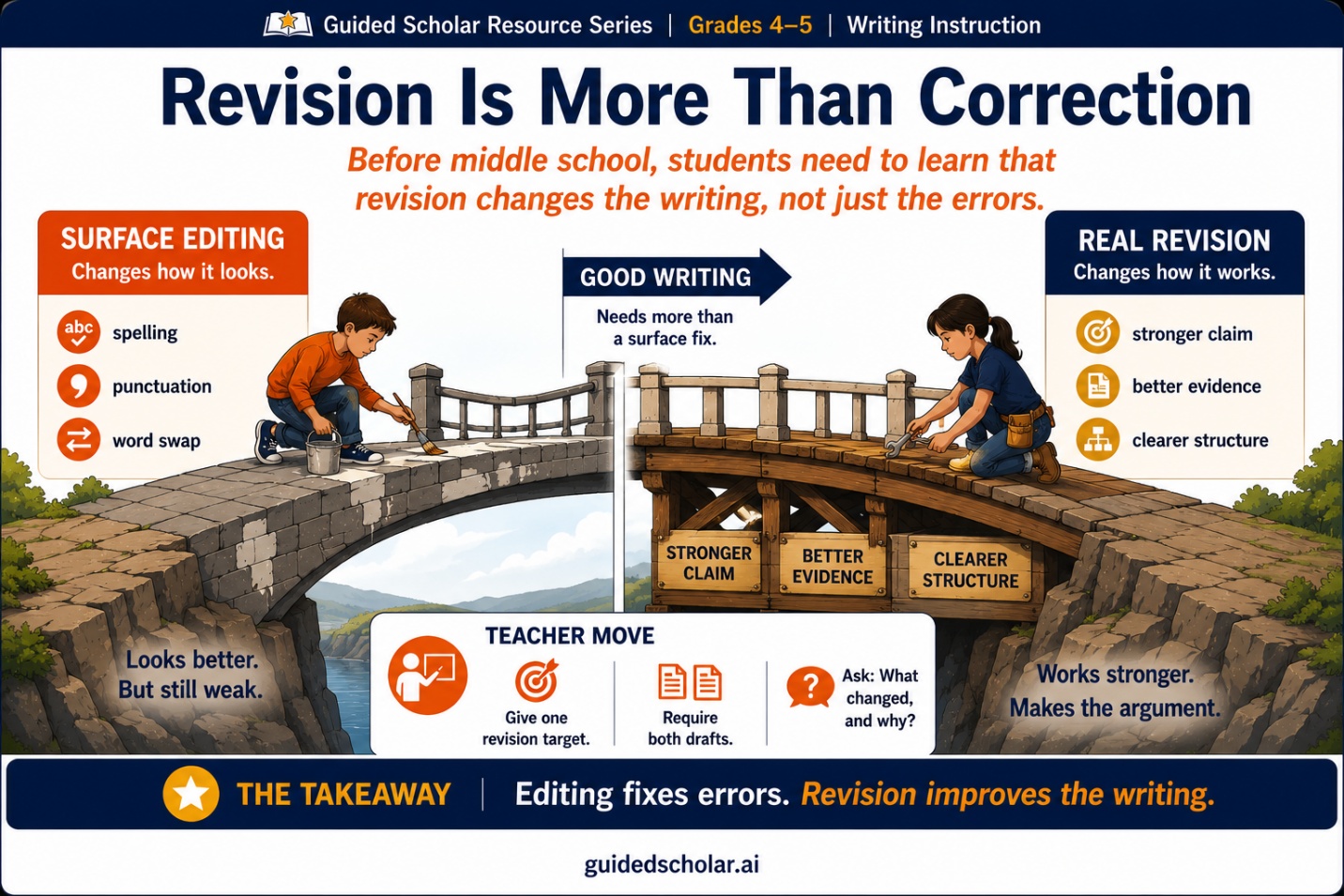
Without explicit instruction in what revision means and what it accomplishes, students at grades 4 and 5 do one of two things. They surface-edit: fix spelling, correct punctuation the teacher marked, swap one word for another. Or they add: append a sentence at the end of a paragraph that was already finished, usually restating something already said.
The student who surface-edits is not misunderstanding the assignment. He is correctly interpreting an assignment structure that has never distinguished surface correction from substantive revision, never shown him what a revised paragraph looks like compared to the original, and never required him to account for what changed and why. He is doing exactly what the system rewards, because the system rewards it.
What Substantive Revision Requires
Substantive revision requires the student to evaluate her own draft against a specific criterion and identify a gap: not just find errors, but identify where the writing fails to do what the assignment asked for. This is metacognitive work. The student must hold the draft at arm’s length, assess what it does and does not accomplish, and decide what to change.
This capacity is developmentally available at grades 4 and 5, but it requires scaffolding. A student told to “make your essay better” cannot engage this capacity without a framework. A student told to “read your second paragraph and find the sentence where your evidence connects to your claim, then write that sentence if it is not there” has a specific target, a specific location, and a specific task. The difference between those two instructions is the difference between a student who changes a spelling error and a student who adds an argument.
The Compounding Problem
Graham and Perin’s Writing Next (2007) identified revision instruction as one of eleven key evidence-based practices in writing development, and noted it was among the most underdeveloped at secondary levels. The underdevelopment at middle school originates upstream. The middle school teacher who faces students with surface-editing habits is managing a problem that became significantly harder to fix between fourth and sixth grade.
NAEP writing assessment data shows that students who demonstrate revision strategies on fourth-grade writing tasks are significantly more likely to score at or above proficiency on eighth-grade writing assessments. The revision habit is the mechanism through which writing improves over time, and it needs a functional foundation before the work gets hard enough to demand it.
Practical Starting Points for Teachers
- Teach the definition of revision before the first revision task. Tell students directly: revision means reconsidering what you wrote, not correcting it. Show a sample paragraph before and after revision where the after version rewrote the central claim rather than fixed a spelling error. Name what happened. Students who have never seen substantive revision cannot aim at a target they have not been shown.
- Assign a specific revision task, not an open revision pass. “Revise your essay” is an invitation to surface-edit. “Read your first body paragraph. Does your evidence connect to your claim? If not, write one sentence that makes the connection explicit.” A specific task at a specific location produces specific engagement.
- Require submission of both drafts. The comparison between a first draft and a revised draft is the only evidence that revision happened. When students submit only the final version, revision is invisible. When both versions are required, the teacher can see what changed.
- Focus one revision criterion per assignment. Revision for everything at once produces surface corrections. Revision for a specific criterion, evidence connection this assignment, claim clarity the next, produces focused engagement with a specific skill. Rotating the focus across the year builds a comprehensive revision repertoire.
- Require a brief written reflection on every revision. Two sentences: what did you change, and why? This requirement forces students to be conscious about the revision decision rather than automatic. A student who cannot explain what she changed has made a correction, not a revision.
The Through Line
The revision habit that determines a student’s writing trajectory through secondary school is built, or not built, in the upper elementary years. A teacher who makes genuine revision instruction a priority at grades 4 and 5 is not enriching the curriculum. He is building the foundational skill the middle school curriculum will assume already exists. Most programs act too late. The window is grades 4 and 5, when the habit is still forming, the work is becoming complex enough to reward substantive reconsideration, and the cost of getting it wrong is still low enough to take the instructional risk.
Sources referenced: Graham, S. & Perin, D., Writing Next (Alliance for Excellent Education, 2007); National Assessment of Educational Progress (NAEP) Writing Data, National Center for Education Statistics; Applebee, A.N. & Langer, J.A., The State of Writing Instruction in America’s Schools (Center on English Learning and Achievement, 2006).