Most middle school writing assignments include revision. Most middle school students do not revise in any meaningful sense. They change a few words. They fix the errors a teacher circled. They add a sentence at the end of a paragraph that already said what they were trying to say. Then they resubmit. The problem is not attitude or motivation. The problem is that the assignment structure treats revision as a single event rather than a repeatable process, and students respond rationally to what the structure actually rewards.
This distinction matters because revision is not a natural impulse. For an experienced writer, holding a draft at arm’s length and reconsidering fundamental choices—reorganizing paragraphs, replacing a weak claim with a stronger one, cutting a section that muddies the argument—is a developed skill that required years of deliberate practice to build. Middle school students are not failing at something they know how to do. They are showing the correct response to a system that has never made substantive revision visible, required, or assessed as distinct from surface-level correction.
Why Surface Corrections Win
Substantive revision requires the writer to hold two versions of a piece in mind simultaneously: the draft that exists and the argument the draft should make. Then the writer must identify the gap between them and make a series of decisions about how to close it. This is abstract, metacognitive work that middle school students are still developing the capacity to do reliably.
Surface editing, by contrast, is tactile, fast, and concrete. A misspelled word is wrong in an objective, visible way. An underdeveloped argument is wrong in a way that requires judgment to identify and sustained effort to address. Given the choice between a task that produces a visible result in two minutes and one that requires re-entering the thinking that produced the original draft, students consistently choose the former. This is not a character flaw. It is a rational response to ambiguous feedback and structural rewards that do not distinguish between the two types of change.
Three Conditions That Make Revision Work
Research on effective writing instruction consistently identifies three conditions that separate meaningful revision from performative compliance.
Criteria-specific feedback tells students what is wrong and where in the draft to look. “Make this better” is not feedback. It is an invitation to guess, and students who guess tend to guess in the direction of surface corrections. Hattie and Timperley’s 2007 meta-analysis in the Review of Educational Research found that the most effective feedback specifies both the nature of the gap and what a correct performance looks like. A student who receives the feedback “your claim in paragraph two makes an assertion but does not respond to the obvious objection” knows where to look and what to do. A student who receives “strengthen your argument” does not.
Bounded revision cycles direct student attention to one specific criterion, one section, one cycle. Open-ended revision passes produce surface edits because students diffuse their effort across the whole document rather than concentrating it where change is needed. The constraint is not a limitation on what the student can do. It is the mechanism that makes revision specific enough to act on. A student told to revise his entire argument cannot locate the problem. A student told to revise the claim in paragraph two against a specific criterion has a target.
Teacher visibility into the revision process is the condition that makes the first two assessable. When a teacher can only see the final draft, he cannot determine whether revision happened at all, whether the feedback was engaged with, or whether the student changed anything of substance. Visibility into draft history—what changed, when, and how—transforms revision from a private, invisible act into an instructional event the teacher can read and respond to. A student who received specific feedback and revised substantively has demonstrated something. A student who received the same feedback and changed three words has demonstrated something different. Only a teacher with access to both drafts can tell them apart.
The Developmental Argument
The case for structural revision support in middle school is not only practical. It is developmental.
Grades 6 through 8 are where students transition from narrative to analytical writing. In elementary school, students write primarily about personal experience—a cognitive task with a lower metacognitive demand than argument construction. In middle school, the expectation changes: analyze this text, argue this position, support this claim with evidence. Revision becomes consequential in a new way because the writing is now making claims that could be wrong, not just recounting events that did or did not happen.
Steve Graham and Dolores Perin’s Writing Next identified structured revision instruction as one of the eleven most evidence-supported practices in adolescent writing. The meta-analysis found it particularly underdeveloped at the middle school level, where assignment structures tend to prioritize completion over process. Students who receive no structured revision instruction during this window are significantly more likely to produce surface-level corrections throughout secondary school. The habits that form in grades six through eight travel directly to ninth grade and beyond.
What This Looks Like in Practice
A revision system does not require a fundamentally different assignment structure. It requires three specific changes to how the existing structure handles feedback and iteration.
The feedback students receive must be specific enough to act on and tied to the criteria they were given before they wrote. A rubric category that says “evidence” supports scoring. It does not support revision. Feedback that says “your second example in paragraph three does not connect to your claim—explain how it supports what you argued in sentence one” gives the student a specific target and a specific location.
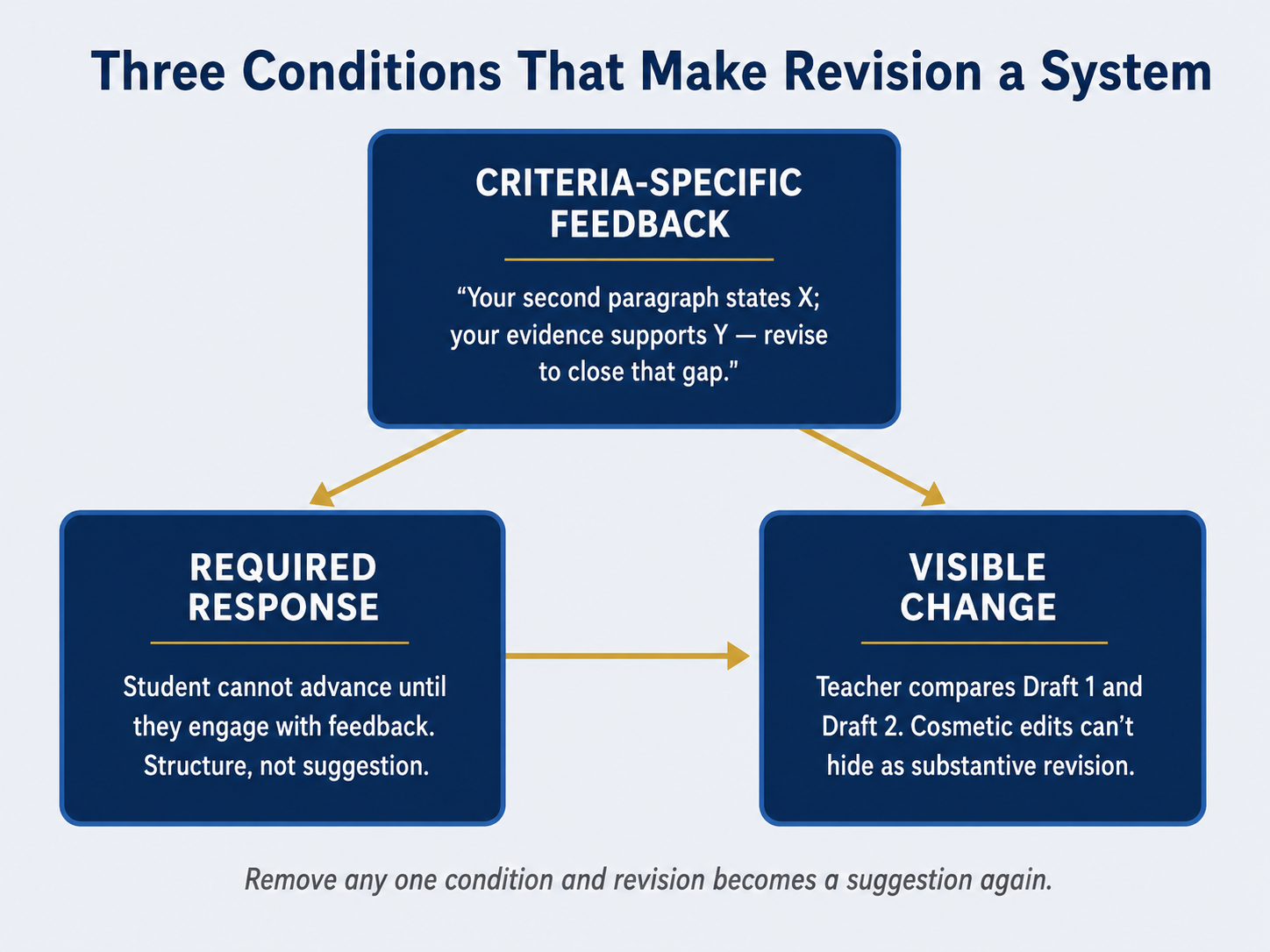
The structure must require a student response to feedback before he can move to a final submission. This is not punitive. It is the mechanism that makes feedback functional rather than decorative. Students who know they must respond to feedback in a traceable way treat feedback differently than students who know they can ignore it.
The teacher must be able to see the comparison between Draft 1 and Draft 2. Without that comparison, revision becomes a private act with no accountability and no instructional value. With it, the teacher can identify which students engaged substantively and which students changed three words and resubmitted.
What This Looks Like in Guided Scholar
Guided Scholar’s Teach Me mode builds the feedback-revision loop into the workflow section by section. A student submits his draft paragraph by paragraph and receives criteria-specific feedback aligned to the teacher’s rubric and assignment, not general writing advice. The feedback identifies what is underdeveloped and where in the draft to look. The student can then revise that section, receive another feedback cycle, and continue working through the feedback until satisfied with the work before moving to the next section.
The teacher dashboard shows the full session: what the student submitted at each stage, what feedback was delivered, and how the draft changed in response. A teacher who can see that a student engaged with multiple specific feedback cycles and revised substantively across each one has evidence of learning that a final submission alone cannot provide. The three conditions a revision system requires—specific feedback, required response, visible change—are not settings the teacher has to configure. They are the structural features of the workflow itself.
The Through Line
The gap between knowing what effective revision instruction requires and implementing it is structural. Most writing assignments are designed around submission events, not revision cycles. A teacher who wants to build genuine revision habits into his classroom needs assignment infrastructure that makes draft history visible, criteria-referenced feedback deliverable, and revision cycles manageable across a full class load. Without that infrastructure, the evidence-based practice remains a good idea that does not scale.
Remove any one of the three conditions — specific feedback, required response, visible change — and revision becomes a suggestion again. The teachers who build consistent revision habits in middle school do something structural, not inspirational: they design a workflow where revision is a required cycle inside the process, not a step appended at the end.
Sources referenced: Graham, S. & Perin, D., Writing Next (Alliance for Excellent Education, 2007); Hattie, J. & Timperley, H., “The Power of Feedback,” Review of Educational Research (2007); Applebee, A.N. & Langer, J.A., “A Snapshot of Writing Instruction in Middle Schools and High Schools,” English Journal (2011).