A fifth-grade teacher marks a set of persuasive essays and notices a consistent structural pattern. Each paragraph contains four or five grammatically correct sentences. The punctuation is accurate. The sentences are clear. But the paragraph does not make a point. It circles an idea without landing on one, or it opens with a statement and then lists loosely related details that do not develop the opening or connect to each other. The sentences work. The paragraph does not.
This is the paragraph problem at grades 4 and 5. Students at this level have largely mastered sentence-level mechanics. What they have not mastered is how sentences work together to develop an idea: how a paragraph functions as a unit of reasoning rather than a collection of related details. The gap is conceptual, not mechanical, and it requires a different kind of instruction to close.
What a Paragraph Is Supposed to Do
An effective paragraph at the upper elementary level does one thing: it develops a single idea fully enough that the reader understands what the idea is, why it matters, and how it connects to the piece’s larger argument or explanation. This requires a topic sentence that states the idea, supporting sentences that develop it with evidence or explanation, and a closing thought that connects back to the main point.
Most students at grades 4 and 5 know that paragraphs have topic sentences. They have been told this repeatedly. What they have not been shown is what it means for the remaining sentences to develop the topic sentence rather than add loosely related information. The difference between developing and adding is the difference between an argument and a list, and most upper elementary writing is a list.
What Upper Elementary Paragraphs Actually Do
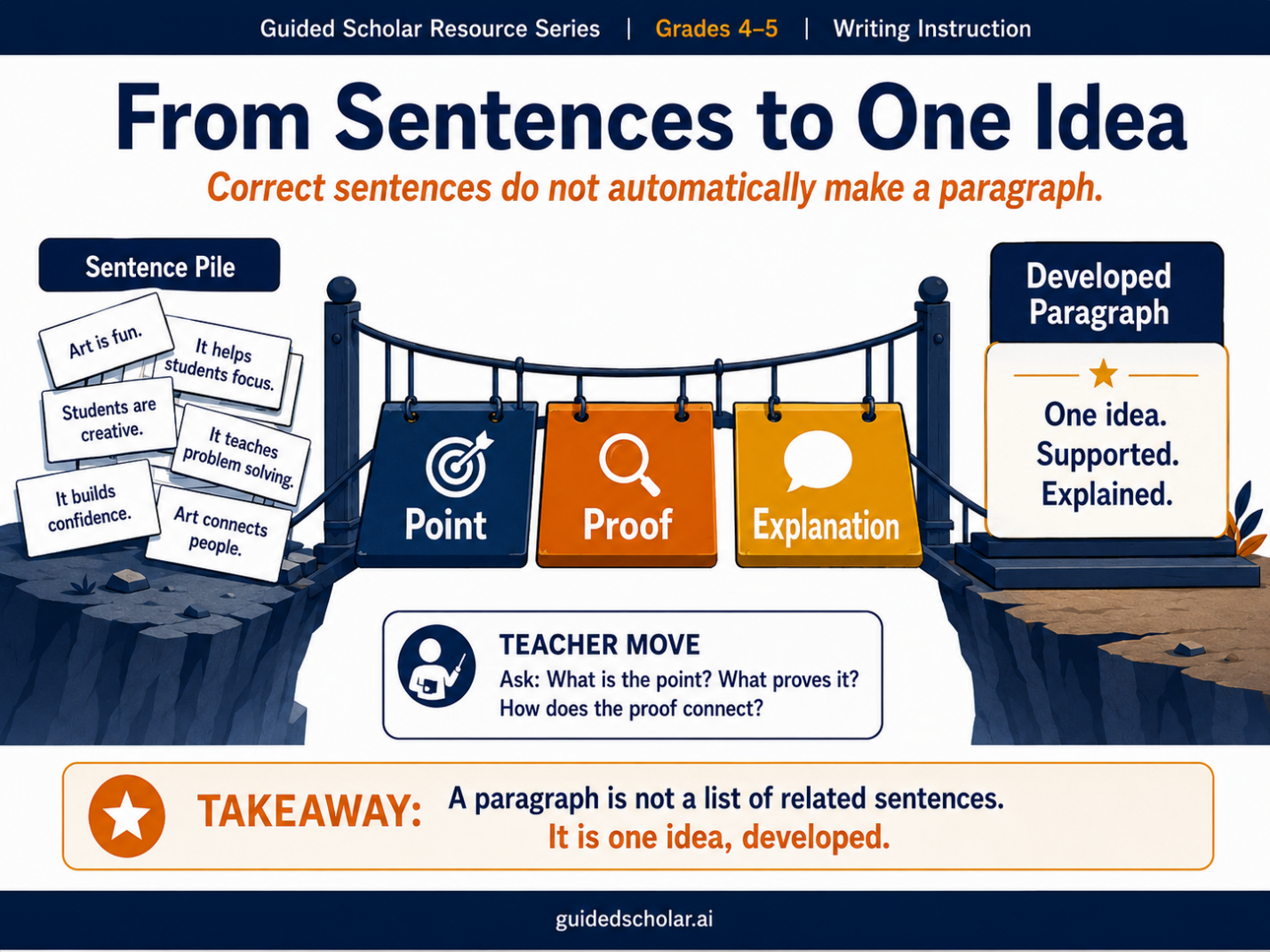
The most common failure is the listing paragraph: a topic sentence followed by several details that relate to the same general topic without building on each other or developing the opening claim. A student writing about why schools should have more art classes might open with “Art classes help students in school.” She then writes: “Art makes you creative. It is fun. It also helps students focus.” Each sentence is plausible. None of them develops the claim in the topic sentence. The paragraph asserts and lists. It does not reason.
A second common failure is the circular paragraph: the student makes a valid point in the topic sentence and restates it in slightly different words for the next three sentences without adding evidence, explanation, or reasoning. The paragraph is coherent but goes nowhere. The student rehearsed the same idea rather than developing it. A reader who finishes the paragraph knows what the student thinks but not why the student is right.
Why the Problem Is Not Mechanical
The paragraph problem looks like a writing mechanics issue, but treating it as one sends instruction in the wrong direction. A student who writes grammatically correct sentences is not failing because of a mechanics gap. She is failing because she has not been taught that a paragraph is an argument, and that each sentence should do specific work in the development of that argument.
This distinction changes what instruction is required. If the paragraph problem is mechanical, the solution is more practice. If it is conceptual, practice without instruction reinforces the existing pattern. The student who writes listing paragraphs and is told to write more will write more listing paragraphs. What she needs is a model of what paragraphs accomplish and explicit instruction in how to produce one that develops rather than lists.
The Research Context
George Hillocks’ research in Teaching Writing as Reflective Practice (1995) consistently found that students who received explicit instruction in the structure and purpose of paragraphs, not just rules about what paragraphs contain, produced significantly more coherent arguments than students who practiced paragraph writing without that instruction. The difference was not effort or ability. It was whether students understood what they were trying to produce.
Graham and Perin’s Writing Next (2007) identified the development of writing strategies as a high-effect practice across grade levels. Paragraph construction is a strategy, not a reflex. It develops through instruction in what paragraphs accomplish, not through repeated practice of the same underdeveloped form.
Practical Starting Points for Teachers
- Redefine the paragraph for students. Replace “a paragraph is a group of related sentences” with “a paragraph makes one point and proves it.” The second definition gives students a functional understanding of what the paragraph is supposed to accomplish. The first does not.
- Use a point-proof-explanation structure explicitly. A paragraph has a point (topic sentence), proof (evidence or detail), and an explanation of what the proof shows. Teaching students to check for all three elements when revising gives them a concrete framework for identifying what is missing.
- Practice paragraph revision before full-essay revision. Isolate a single paragraph and ask: what is the point? What is the proof? Does the proof connect to the point? This focused analysis builds the skill faster than asking students to revise a full essay at once.
- Model listing paragraphs and developed paragraphs side by side. Show students two versions of the same paragraph: one that lists details and one that develops a single idea with evidence and explanation. Ask which one makes a stronger case and why. The comparison gives students a concrete target.
- Use sentence frames that require connection. “This shows that...” and “This matters because...” force students to connect evidence to their point. These frames build the habit of connecting that students will eventually internalize and no longer need.
The Through Line
The paragraph problem at grades 4 and 5 is a conceptual gap, not a mechanical one. Students who write correct sentences but cannot write developed paragraphs do not need more practice. They need instruction in what paragraphs are for. The teacher who reframes the paragraph as an argument, a unit of reasoning that makes one point and proves it, gives students a model that transfers to every genre they will write in at every grade level that follows. The instruction that addresses this gap at grade 5 is the instruction that makes everything after it easier.
Sources referenced: Hillocks, G., Teaching Writing as Reflective Practice (Teachers College Press, 1995); Graham, S. & Perin, D., Writing Next (Alliance for Excellent Education, 2007); Common Core State Standards for English Language Arts.