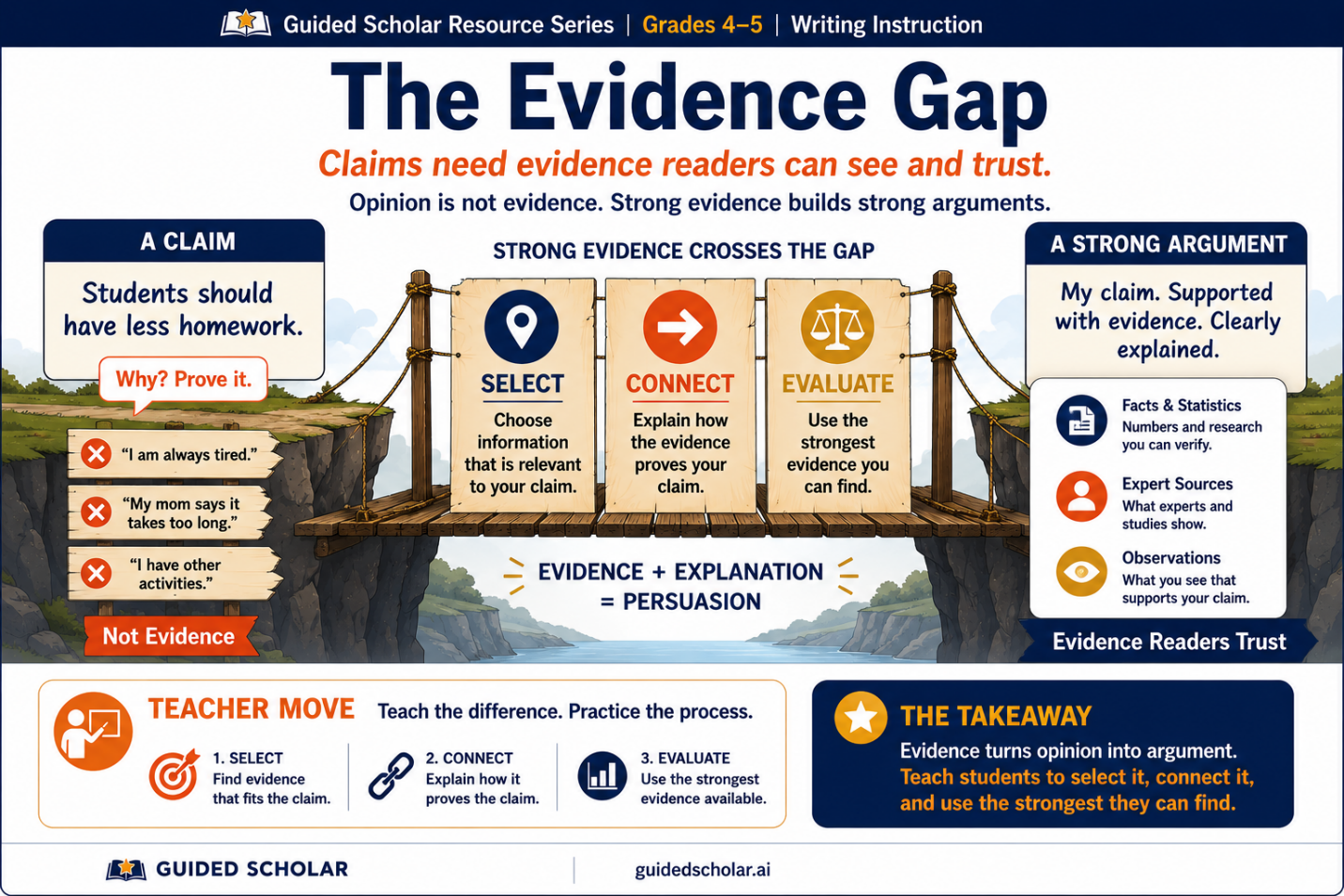
A fifth-grade teacher reads through a set of opinion essays on whether students should have homework. The papers uniformly argue that homework is too much and should be reduced. The arguments share the same structure: a claim followed by personal reasons, followed by a conclusion that restates the claim. The evidence offered includes: “I am always tired.” “My mom says it takes too long.” “I have other activities.” None of these are evidence in the argumentative sense. They are personal statements that assume the reader already agrees.
This is the evidence gap at grades 4 and 5. Students understand they are supposed to support their claims. They do so consistently, using the only evidence strategy most of them have: personal experience and personal opinion. They cannot yet distinguish between a reason that depends on the reader sharing their experience and a reason that would persuade a reader who does not.
What Evidence Actually Requires
Evidence in argumentative writing is not the same as a reason the writer finds compelling. It is information that a reader who does not already agree could evaluate, verify, and potentially be persuaded by. Producing that kind of evidence requires three distinct skills that upper elementary students are rarely taught in sequence.
Selection is the first: identifying information relevant to the specific claim being made, not just information the writer already knows about the general topic. A student arguing that recess improves academic performance who cites facts about how much energy children have is not making the connection. A student who cites research linking physical activity to concentration is.
Connection is the second: explicitly linking the evidence to the claim. Most upper elementary students cite evidence and assume the connection is obvious. It is not. The connection is the argument, and it must be stated. A student who cites a statistic and moves on has cited evidence. A student who cites the statistic and then explains what it proves about her specific claim has made an argument.
Evaluation is the third: recognizing that different types of evidence carry different persuasive weight. A personal story is one type. A statistic from a credible source is another. An expert’s finding is another. Students who begin to distinguish these types at grades 4 and 5 are developing a critical thinking skill that academic writing at every subsequent level demands.
Why Personal Opinion Dominates
Students default to personal experience for two reasons that reinforce each other. First, it is immediately available. A student who needs to support a claim about homework can reach for her own experience in seconds. Finding relevant information from outside her personal knowledge takes effort and requires a process most fourth graders have not been taught.
Second, personal experience has been rewarded. From kindergarten through third grade, personal experience was the content of most writing assignments. Students who drew most directly on their own lives received strong feedback. When the expectation shifts to opinion and argument at grade 4, students bring the same strategy that worked before. No one has yet told them it no longer applies, and the assignment prompt alone does not make that clear.
The Three Evidence Failures
Unsupported assertion is the first and most common: the student states a claim and moves on without any supporting information. The assertion stands alone with no evidence offered.
Personal opinion as evidence is the second: the student provides support, but the support is personal reaction or preference. The support depends entirely on reader sympathy rather than verifiable information. A reader who does not share the student’s experience has no reason to be persuaded.
Disconnected evidence is the third: the student provides information that relates to the general topic without connecting it to the specific claim. Citing facts about sleep deprivation in children while arguing for longer recess, without explaining how one supports the other, is disconnected evidence.
What the Research Says
The National Writing Project’s research on upper elementary writing has consistently found that students who receive explicit instruction in evidence selection and explanation outperform students who receive only prompts to “support your ideas.” The difference is not the amount of writing practice. It is whether students were taught a process for choosing and connecting evidence, or simply told that evidence should be present.
Graham and Perin’s Writing Next (2007) identified explicit strategy instruction in evidence use as a high-effect practice across grade levels, including elementary. The ability to select relevant evidence and explain its connection to the claim determines writing quality more consistently than any mechanical variable.
Practical Starting Points for Teachers
- Teach the “This shows that...” sentence frame before any argument assignment. This single structural requirement forces students to articulate the connection between evidence and claim. Without the frame, students cite and move on. With it, they must construct the argument.
- Sort evidence by type before writing. Have students categorize their planned support: personal experience, personal observation, a fact from a text, or an expert’s view. The sorting makes the hierarchy of evidence types visible without requiring a lecture on it.
- Model evidence selection for a specific claim. Present two pieces of evidence. Ask which one actually supports the specific claim being made. The discussion surfaces the difference between relevant and irrelevant support.
- Build an evidence revision pass into every assignment. After a first draft, ask students to check each piece of evidence: does this connect to my specific claim? Is the connection stated? This revision focus directs attention to the skill rather than surface mechanics.
- Require at least one non-personal piece of evidence per piece. This structural requirement forces students beyond personal experience, even if research at grade 4 means a fact from an assigned informational text. The requirement makes the distinction between personal and external support a concrete expectation.
The Through Line
The evidence gap at grades 4 and 5 is a process problem, not a knowledge problem. Students often know things about their topics. What they lack is a reliable method for selecting evidence that supports a specific claim rather than illustrates a general point, and for explaining the connection between the evidence and the claim they are making. That process is teachable, and it is the foundation of everything that argumentative writing will ask of students at every grade level that follows. A teacher who builds evidence instruction into her practice at grades 4 and 5 is closing a gap the middle school curriculum will assume was already closed.
Sources referenced: National Writing Project, Because Writing Matters (Jossey-Bass, 2006); Graham, S. & Perin, D., Writing Next (Alliance for Excellent Education, 2007); National Assessment of Educational Progress (NAEP) Writing Data, National Center for Education Statistics.