Most ACT writing preparation focuses on structure and timing: a thesis, three body paragraphs, a conclusion, forty minutes. Students practice this formula, improve their writing speed, and arrive at the exam with a clear procedure for producing a complete essay. Their scores do not move in proportion to the preparation time invested, because the formula does not address what the rubric measures.
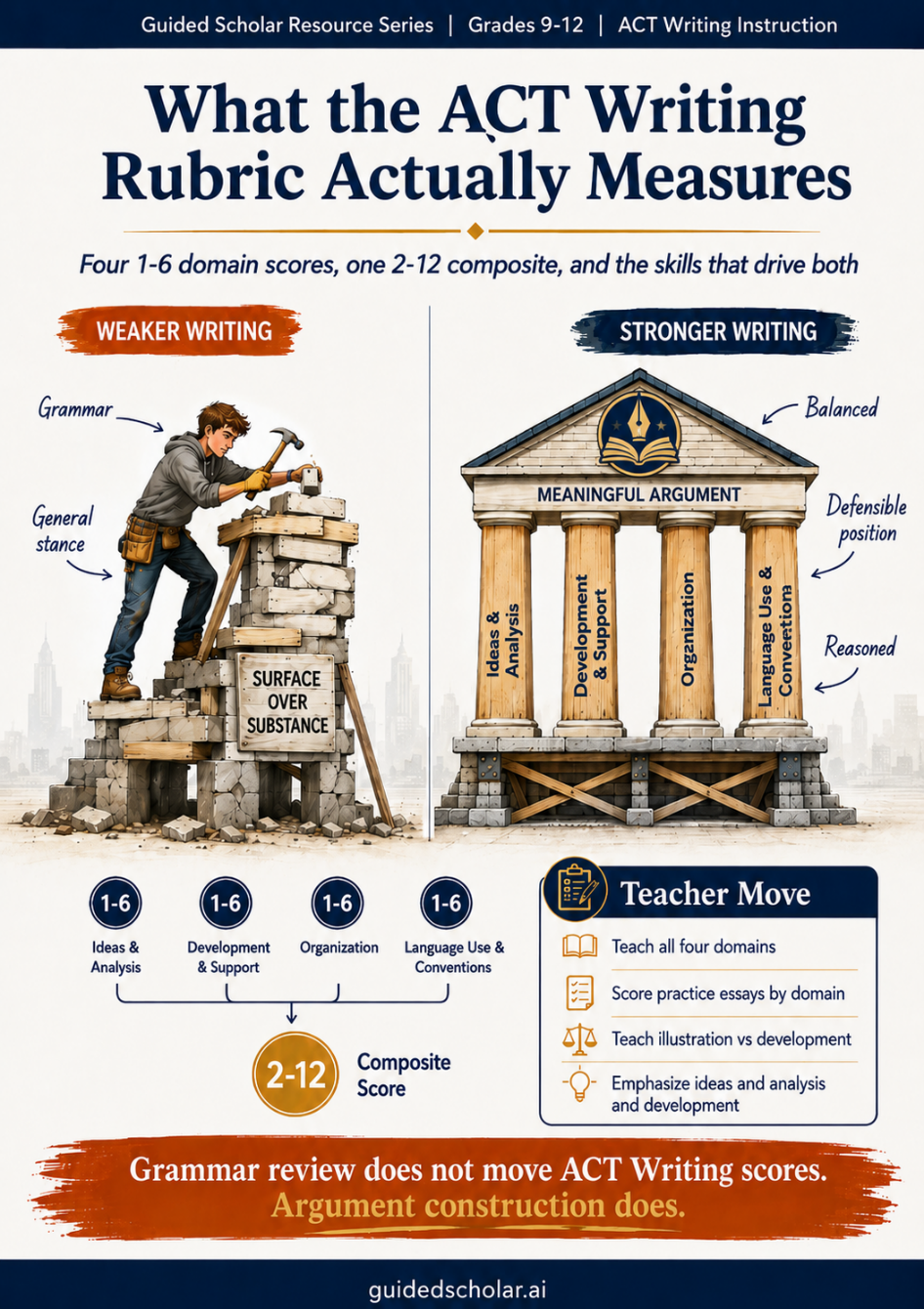
The ACT Writing essay is scored through four domains. In Guided Scholar, each domain is reported on a 1-6 scale, and the final ACT Writing composite is reported on a 2-12 scale. That distinction matters: domain scores diagnose the specific writing skill, while the composite shows the overall writing result. Understanding what each domain actually rewards is the prerequisite for any preparation that changes scores. Most students walk into the exam without that understanding, and most preparation programs do not provide it.
Ideas and Analysis
Ideas and Analysis asks whether the essay takes a clear, specific, defensible position on the prompt’s central question, whether it engages with why the issue is contested, and whether the writer demonstrates understanding of what is actually at stake. It is the domain most students underestimate and most preparation programs underemphasize.
A domain score of 3 or 4 typically reflects an essay that states a position and restates it across paragraphs without developing why the position is defensible. A 5 reflects an essay that takes a position and demonstrates awareness that the question is genuinely contested, that reasonable people disagree, and that the disagreement reflects a difference in values or priorities rather than a misunderstanding. A 6 reflects an essay that engages with the complexity of the issue and addresses why competing positions exist rather than simply asserting they are wrong. This domain is where argument construction lives.
Development and Support
Development and Support asks whether the essay develops its argument through reasoning and evidence, not just examples. The critical distinction is between illustration and development. Illustration drops an example and moves on. Development explains how the example supports the specific claim being made and why it matters to the argument.
A student who writes “technology helps students learn, for example, many schools use tablets” has illustrated a claim. A student who writes “technology can help teachers catch problems sooner because online practice shows which skill a student missed that day, before the student falls further behind” has developed one. The second version explains why the example matters. The first only names an example. Essays that illustrate consistently score in the 3-4 range on this domain. Essays that develop well can reach 5 or 6.
Organization
Organization rewards logical progression of argument and transitions that explain the relationship between ideas rather than simply mark their sequence. “First, second, additionally, in conclusion” is labeling, not organization. High-scoring organization means each paragraph does specific work in the development of the thesis, the sequence of paragraphs is driven by the argument rather than by convention, and the relationships between paragraphs are made explicit.
Students who write three body paragraphs that each make an independent general point in favor of their thesis are not demonstrating the organization the rubric rewards. They are demonstrating the five-paragraph structure. The rubric rewards argument logic, not paragraph format.
Language Use and Conventions
Language Use and Conventions is the domain students assume matters most. It does not. Consistent grammar, clear syntax, and appropriate word choice usually produce a functional domain score. The domain rewards precision and variety, but mechanical errors do not collapse an otherwise strong argument essay the way students fear. A student with Ideas and Analysis at 5 and Language Use at 4 is better positioned for a strong final composite than a student with perfect mechanics and weak argument development across the reasoning domains.
The practical implication of this ordering is counterintuitive for most students. Grammar review does not move ACT Writing scores. Argument construction does. A teacher who prepares students primarily by reviewing sentence-level mechanics is spending preparation time on the domain with the lowest ceiling for score improvement.
The Hierarchy That Drives Preparation
ACT Inc.’s own rubric documentation makes this hierarchy explicit. The highest performance descriptors for Ideas and Analysis describe an essay that “engages critically with multiple perspectives” and generates an insightful response. The highest descriptors for Development describe “thorough reasoning” with strong support. Language Use’s highest descriptor addresses skillful word choice. The order of ambition in the rubric’s language matches the order of instructional priority that preparation should follow.
Practical Starting Points for Teachers
- Teach the four domains before the first practice essay. Students who understand what they are being scored on make different choices than students who are guessing. A brief rubric orientation before any practice writing changes how students approach the task.
- Score practice essays by domain, not just composite. A domain breakdown tells a student her Ideas and Analysis is a 4 and her Development is a 3. A final composite score alone does not show where the problem is. The breakdown is the diagnostic that drives focused preparation.
- Teach the illustration-versus-development distinction explicitly. Show two versions of the same body paragraph: one that cites an example and moves on, one that explains what the example establishes and why it matters to the claim. The comparison makes the difference concrete and gives students a target.
- Build argument construction before timed writing. Students who have never practiced constructing an ACT-style argument in untimed conditions cannot produce one in forty minutes. Build the skill before testing it under time pressure.
- Prioritize feedback on Ideas and Analysis and Development. These domains have the highest ceiling for score improvement. Detailed feedback on Language Use mechanics for a student whose Development scores at 4 is preparation time spent on the wrong problem.
The Through Line
The ACT Writing rubric measures argument quality, not writing fluency. Structure is necessary but not sufficient. Fluency is necessary but not sufficient. The essays that score at the top of the rubric are essays that take a defensible position, develop it through reasoning, and engage with the complexity of the issue. Those skills are teachable. They require explicit instruction in what they demand, not simply repeated practice producing essays that illustrate rather than develop.
ACT Inc., ACT Writing Test Rubric (2016); ACT Inc., Condition of College and Career Readiness Report (annual); Hillocks, G., Teaching Argument Writing, Grades 6–12 (Heinemann, 2011).