Every ACT Writing prompt provides three numbered perspectives on its central issue. Most students read these perspectives, form an opinion, and write an essay that expresses that opinion with supporting examples. They acknowledge the perspectives in an introduction sentence or two and then write as if those perspectives do not exist. This approach often stays at 4 or below on Ideas and Analysis regardless of how well the rest of the essay is written.
The perspectives requirement is one of the most misunderstood elements of the ACT Writing task, and one of the most consequential for scores. A teacher who prepares students for the ACT without directly addressing what “engaging” a perspective means is leaving significant score improvement on the table.
What the Rubric Means by Engagement
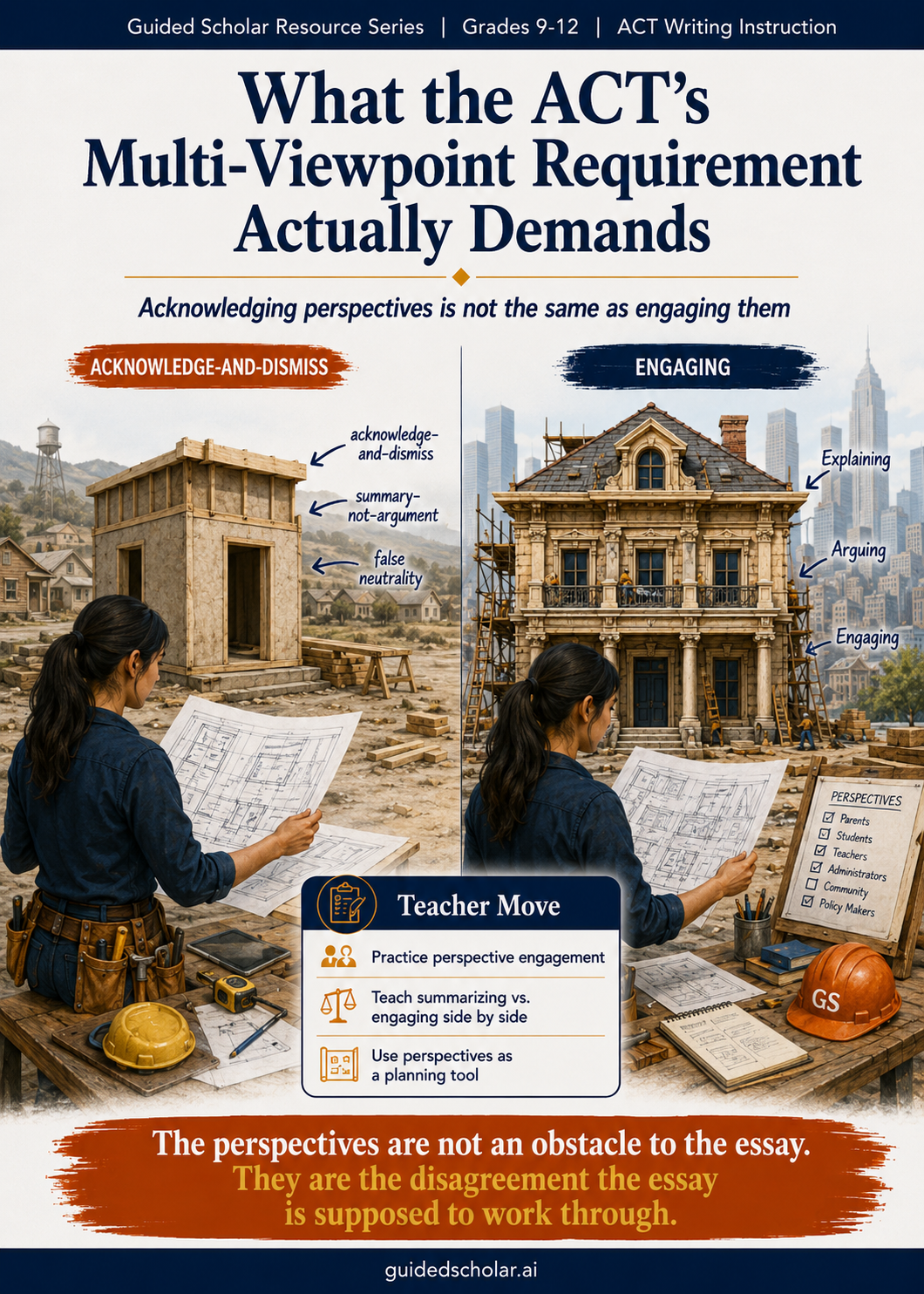
The ACT rubric distinguishes between essays that acknowledge perspectives and essays that engage them. Acknowledging means noting that a perspective exists. Engaging means arguing in relation to it: explaining where it is correct, where it is incomplete, where it contradicts another perspective, or how it relates to the student’s own claim.
Engagement does not require agreement. A student who disagrees with a perspective and explains specifically why it is wrong has engaged it. A student who agrees with a perspective and extends its logic to support his own claim has engaged it. A student who reads the perspective, accurately summarizes what it says, and moves on has not engaged it, regardless of whether he agrees or disagrees.
This distinction matters for two domain scores simultaneously. Both Ideas and Analysis and Development and Support reward perspective engagement. An essay that shows genuine engagement with at least two of the three perspectives consistently scores higher on both domains than an essay that acknowledges all three and engages none. The perspectives are not a box to check. They are the intellectual material the essay is supposed to use.
The Three Engagement Failures
The acknowledge-and-dismiss pattern is the most common. The student references a perspective in his introduction, dismisses it with a single sentence of disagreement, and moves to his own position. This acknowledges the perspective without engaging it. The rubric requires more: if a perspective is worth dismissing, the essay must explain specifically why it is wrong and what that wrongness reveals about the issue.
The summary-not-argument pattern is the most recognizable. The student devotes a paragraph to each perspective, accurately describing what each says, and then presents his own argument as a fourth section. The perspective paragraphs contain no argumentative content. They establish that the student read the material. They do not demonstrate that he can argue in relation to it. This structure looks organized. It scores in the 4 range on both Ideas and Analysis and Development.
The false neutrality pattern is the least obvious. The student decides all three perspectives have valid points and writes an essay acknowledging strengths and weaknesses of each without taking a position. This reads as balanced analysis. It scores poorly on Ideas and Analysis because the rubric requires a position. Synthesis without a position is not argument. It is description of disagreement.
What the High-Scoring Essay Does Differently
An essay that earns a 5 or 6 on Ideas and Analysis uses the perspectives as part of its argument rather than as opening background. It positions its own claim in relation to the perspectives: one perspective is right about X but misses Y, another identifies the right problem but gives the wrong solution, and the third assumes something the prompt does not support.
This approach does not require equal treatment of all three perspectives. An essay that fully engages two and briefly acknowledges the third is sufficient for high scores. What is not sufficient is any structure that treats the perspectives as obstacles to clear before the essay can begin.
The Research Context
Graff and Birkenstein’s They Say / I Say (2006) identifies the same thinking skill the ACT rubric is measuring: the ability to make a claim while responding to other claims. Their research on student writing found that students who learned to respond to competing positions before stating their own produced stronger arguments than students who learned only to state and support a thesis. The ACT perspectives requirement applies this principle in a timed testing context. The perspectives define the disagreement. The essay works through that disagreement instead of pretending it does not exist.
Practical Starting Points for Teachers
- Practice perspective engagement before full essay writing. Assign single-paragraph exercises: given a perspective, write a paragraph that either extends it, challenges it, or explains how your own position relates to it. Isolating the skill makes it learnable before it must be performed under time pressure in a full essay.
- Teach summarizing versus engaging with a side-by-side comparison. Show two paragraph versions of the same perspective response: one that describes what the perspective says and one that argues in relation to it. The comparison gives students a concrete target and makes the distinction visible before they must produce it.
- Use the perspectives as a planning tool, not a writing task. Before students write a word of essay prose, have them map: which perspective most supports my claim and why, which do I disagree with and what specifically is wrong with it, what does my claim address that none of the perspectives fully captures? This pre-writing step converts the perspectives from an obstacle into usable material.
- Score perspective engagement separately. Ask students to assess their own essays: did you engage or summarize? Using the distinction explicitly during self-evaluation develops the self-assessment capacity that transfers to timed conditions.
The Through Line
The perspectives are not an obstacle to the essay. They are the disagreement the essay is supposed to work through. A student who treats them as a box to check has understood the surface form of the task without understanding its purpose. The preparation that addresses this gap teaches students to argue in relation to other positions, not just to state and support their own. That is the difference between a 4 and a 5 or 6 on Ideas and Analysis, and it is fully teachable with the right approach.
ACT Inc., ACT Writing Test Rubric (2016); Graff, G. & Birkenstein, C., They Say / I Say (W.W. Norton, 2006); Hillocks, G., Teaching Argument Writing, Grades 6–12 (Heinemann, 2011).