The most common observation in ACT Writing feedback is that the student’s essay lacks a clear argument. Most students who receive this feedback understand it as a request for a stronger thesis. They revise by making the thesis more emphatic or more specific in the abstract. Scores do not change, because the problem is not emphasis. It is the difference between a position and a claim.
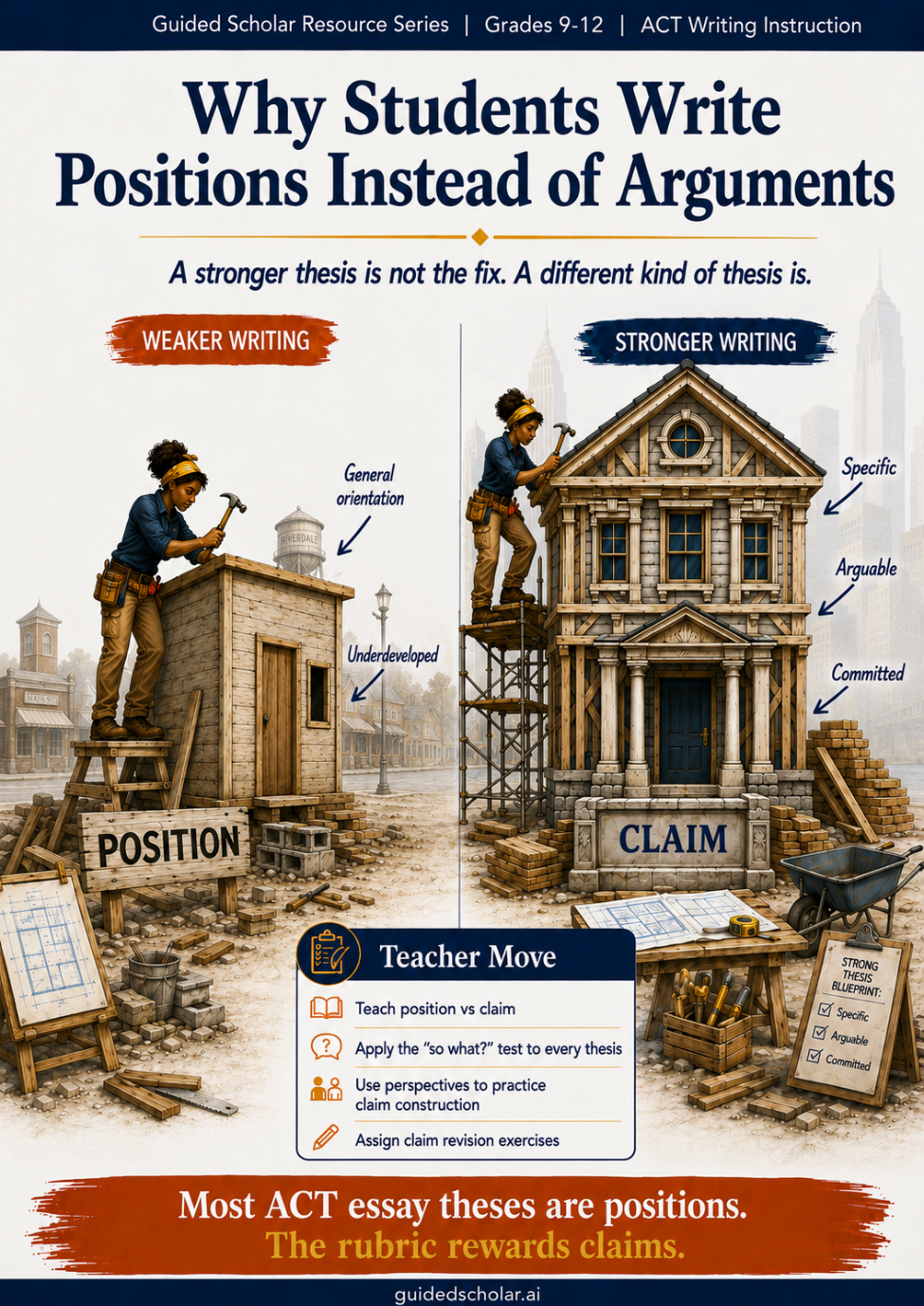
A position is a general orientation toward the issue. A claim is specific, arguable, and makes a commitment the essay must honor. Most ACT essay theses are positions. The rubric rewards claims. These are not refinements of the same thing. They are different cognitive tasks, and producing a claim rather than a position requires a different kind of preparation.
The Distinction That Determines the Score
A position on a prompt about artificial intelligence and human potential might read: “Overall, I believe artificial intelligence has more benefits than drawbacks for society.” The student has declared a general orientation. The essay that follows can be almost anything: a survey of benefits in one paragraph, a survey of drawbacks in another, a conclusion that the benefits outweigh. The thesis imposes no real constraint on what the essay must argue.
A claim on the same prompt might read: “Artificial intelligence can help students, but its biggest risk is that students may use it to avoid the hard thinking that builds problem-solving skill.” The student has committed to a specific reason and a specific consequence. The essay cannot be just anything anymore. It must explain how avoiding hard thinking weakens learning and why that risk matters.
The Ideas and Analysis domain scores this distinction directly on the 1-6 scale. An essay that operates at the position level often stays in the 3 to 4 range regardless of how fluent it is. An essay that operates at the claim level has the ceiling to reach a 5 or 6, because it demonstrates that the student has engaged with the complexity of the issue rather than simply declared an orientation toward it.
Why Position-Level Theses Dominate
Students arrive at the ACT having been taught, correctly, that a thesis states the main idea of the essay. At the position level, this is true. A position does state the main idea. But it states it at a level of generality that permits any essay to follow, which means the essay is not required to make a specific argument.
The five-paragraph essay structure, as most students have practiced it, accommodates positions easily and claims poorly. A position allows three independent body paragraphs each making a separate point in favor of the writer’s general orientation. A claim requires three body paragraphs that each develop a specific aspect of the claim’s reasoning. The first structure is easier to execute in forty minutes. The second is what the rubric rewards. Students default to what they can execute under pressure.
George Hillocks’ research in Teaching Argument Writing (2011) identified the failure to construct specific, arguable claims as the primary source of underdevelopment in secondary student argument writing. Students who were explicitly taught to distinguish claims from position statements produced significantly stronger arguments at every grade level. The distinction is teachable. Most preparation programs do not teach it directly.
What Claim Specificity Requires
A strong ACT claim has two properties. It is specific about the reason being asserted: not “technology improves education” but “technology helps teachers spot which students need extra help before they fall behind.” And it is arguable in a particular direction: a skeptical reader can identify what would need to be true for the claim to be wrong, which means the essay makes a commitment it must honor.
A useful diagnostic is whether the claim could be written by any student who had read the prompt, regardless of what they actually think about the issue. If a student with no knowledge of the topic could produce the same thesis, the thesis is a position. A claim the student could write without knowing anything specific is not a claim. It is a placeholder that gives the appearance of a thesis without the argumentative commitment one requires.
Using the Perspectives to Build the Claim
The ACT’s three provided perspectives are not a separate task to address after the claim is constructed. They are material that can help construct a more specific claim. A student who reads the perspectives carefully and identifies how her position relates to each is already doing part of the claim-construction work. A perspective she agrees with points her toward what she wants to argue and why. A perspective she disagrees with tells her what her claim must account for. Using the perspectives as a planning tool for claim construction produces a more specific claim and begins the perspective engagement the rubric requires.
Practical Starting Points for Teachers
- Teach the position-versus-claim distinction before any timed practice. Give students sample thesis statements and ask them to categorize each as a position or a claim, and explain why. The categorization task develops the discrimination before students must produce the distinction under time pressure.
- Use the “so what?” test on student theses. If the thesis answers “so what?” but lacks specifics, it is a position. If it names a specific reason, consequence, or commitment that makes the claim meaningful, it is developing toward a claim.
- Practice claim construction from the perspectives before writing full essays. Before producing any essay prose, have students map how their position relates to each perspective and identify what specific thing they are claiming that the perspectives do not fully address. This pre-writing step produces more specific claims.
- Assign untimed claim revision exercises. Give students position-level theses and ask them to make each into a claim. This targeted practice builds the skill without the time pressure of a full essay. Students who can convert a position to a claim in untimed conditions are building the capacity to start with a claim under timed conditions.
- Score claim specificity before scoring the whole essay. Whether the thesis is a position or a claim is the single most predictive variable for the Ideas and Analysis domain score. Naming it at the draft stage gives the student a specific target before the whole essay must be reconsidered.
The Through Line
The claim problem on the ACT essay is a thinking problem, not a writing problem. A position allows the student to write without deciding what she is actually arguing. A claim requires the decision to be made before the essay can proceed. The instruction that addresses this gap is not more rubric reminders or more practice essays. It is explicit, deliberate work on the distinction between stating an orientation and making an argument, done in untimed conditions before students are asked to execute it in forty minutes.
ACT Inc., ACT Writing Test Rubric (2016); Hillocks, G., Teaching Argument Writing, Grades 6–12 (Heinemann, 2011); Graff, G. & Birkenstein, C., They Say / I Say (W.W. Norton, 2006).